Tuesday, 12 October 2010

The Plague Village and Chatsworth - 2 of my favourite places!

Where it all began...
On Tuesday, September 28th, my students, my parents, Isaac, and Marylinn Thomlinson accompanied me to visit Eyam and Chatsworth House. This is one of my favourite places to visit and the story of the bubonic plague, otherwise known as black death, is at the top of my favourite British history stories. I know this sounds pretty crazy, but when you are a nurse, or even if you aren't, the story of the plague is an amazing one. Maybe by the end of this blog, you might agree with me :)

Black Death began to invade Europe and England in the middle 1300's and continued to spread throughout the 17th century. It was probably caused by a bacteria, Yersinia pestis, that was carried in the blood of black rats. The rats would become infested with fleas, the fleas would bite the rats, and then they would become carriers of the disease. When the rats died, the fleas would then bite people and spread the disease to those they bit. After a person would become infected with Black Death by a flea bite, the bacteria would eventually settle into the human's lungs, and the bubonic plague would then turn into the pnuemonic plague, which was incredibly contagious.

According to the historians, the spread of Black Death began in the countries around the Mediterranean Sea. As people and trade moved north and west, it spread throughout Europe. A boat from Europe sailed into England. The majority of the people on the boat had died of the plague during the journey, and the few that were still alive died shortly once the boat hit the shore. Before anyone knew what had happened, the rats and fleas from this boat invaded England, and Black Death spread throughout the land - especially in cities that were highly populated, like London. 
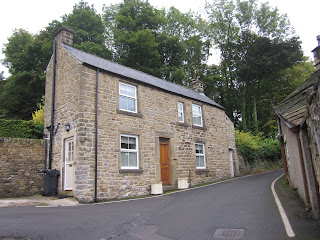
Cottages in Eyam  -they are darling!
The Black Death had an incredible impact on the socioeconomic and health status of the European and British populations during this time. It was incredibly deadly and wiped out 1/3 of the population in Britain and Europe in an incredibly short period of time. It was so powerful, in fact, that the outbreak in 1348 stopped the Hundred Years War for 7 years - too many people were sick, and there weren't enough healthy people to fight in the war as a result of the plague. Black Death continued to be a threat and there were frequent outbreaks of the plague after the initial outbreak in 1348.

The story of Eyam and the Black Death started in 1665. Eyam (I have heard it pronounced I-em and eem - you can say it either way) is a very small village in Derbyshire that was mined for lead by the Romans and was originally settled by the Anglo Saxons. However, Eyam's call to fame is its response to the Black Death in 1665. Here is how the story goes...

In the beginning of September, in 1665, a tailor named George Vicars who was originally from London but now lived in Eyam ordered fabric to make clothes. In those days, it was common for fabric to be sent in chests, and the fabric was often damp. Well, like all other fabric, when this shipment arrived, it was damp, so George took the fabric out and laid it in front of his fireplace to dry. What he didn't know is that the fabric was infested with infected fleas. The fleas jumped out of the fabric and bit him and his helper, and both died within several days of receiving the fabric. George's cottage, known as the plague cottage, still stands today - in fact, the first picture of this blog is a picture of his house. 

Isaac in the gate that leads to the church in Eyam
The plague spread rapidly from George to his neighbors. After the first several deaths, the people of the village turned to their 2 pastors, William Mompesson and Thomas Staley, for advice. Although these 2 gentlemen did not share common religious views, they wisely decided to unite in their recommendations to the villagers. They decided that the villagers should bury their own dead relatives in places other than the village's graveyard to prevent people from being exposed to the plague in town. They also decided that church services should be held outside and most importantly, they convinced everyone in the village to quarantine themselves. These 2 gentlemen had no idea if these interventions would work, but their goal was to stop the spread of the plague outside of their village. They made a deal with the Duke of Devonshire, who lived at Chatsworth House, to provide the villagers with food and supplies during the quarantine period. Somehow, these two pastors were able to convince almost everyone to stay in the village. Due to their efforts, the plague did not spread widely outside of this little village, and the villagers are credited for their heroic efforts to keep everyone else in their area safe. 
The Village Church
We started out our visit at the Plague Museum. The museum is really informative - there is lots to read, and you are not allowed to take photographs in the museum, so I will just try to describe it to you. The first thing we did was watched a video about the plague and the village. We then moved through the displays that explained how the plague spread through the village and shows an epidemiological chart of the people in the village who died at this time. The records from this time are not incredibly accurate, so there has been some debate over how many people lived and died from the plague during this time. Some estimate that out of 350 villagers, 83 survived and at least 260 died, while others estimate that out of 800 villagers, 430 survived. The bottom line is, no matter which estimates are most accurate, that the plague had an incredible impact on this little village. The museum also included some "folk remedies" for the plague - some of which involved using frogs and birds that had their tail feathers removed. You could tell from the potential cures that people were desperate for a cure. After going through the museum, we went on to the church. You cannot take pictures inside of the church, so what follows are some pictures of what we saw in the graveyard around the church. The Celtic cross below was originally at the side of a cart path in Eyam but was eventually moved to the graveyard at the church.
A Celtic Cross in the Church cemetery from the 8th Century AD

Catherine Mompesson's grave - she was the wife of the village's pastor and
died of the plague on 25 August 1666 - there is a yearly event at this grave site to remember the plague 
 Inside the church, there is a section of stained glass that tells the story of the 2 pastors and the Black Death. The original plague cottages are next door to the church - everything in this village is pretty close together, so you can imagine while you are in Eyam how the plague spread so quickly.  The signs and symptoms of the plague were pretty obvious. Usually the victim started with flea bites with large swellings called buboes. These bites were usually in the groin, in the armpits, or in the neck. The swellings were red at first but then became necrotic and turned either dark purple or black due to tissue death (hence the name Black Death), and the person usually died within 2-6 days after the initial symptoms were noticed. When the plague moved to the lungs, the victim began to experience respiratory symptoms such as coughing, sneezing, and difficulty breathing. If the plague invaded the victim's blood stream, it was called septicemic plague, and the person died within a day.
Skull and crossbones on a grave site - this type of death imagery emerged in art
during the time of the plague - it was a recognition that death will come to everyone
As I mentioned earlier, all the families had to bury their own dead. Legend has it that there was a gentleman named Marshall Howe who dug graves for people who could not bury their own. He frequently would take all the family's possessions for payment for digging the graves. Many times, the entire family was wiped out, so I guess he thought he was helping people out in their time of need. The strange thing is that he never contracted the plague even though he had been exposed to it over and over again. Another woman, Elizabeth Hancock, buried her 6 children and her husband in 8 days, but she never became sick herself.
The Lydgate Graves - George Darby and his daughter, Mary, died in 1666
George's wife survived the plague and died from other causes in 1674
The typical reaction to the plague was wide-spread panic and hysteria. People were convinced that God was out to get them and the art during this time became very dark. What is very interesting is that although many people died, there were others who were exposed to the plague that never came down with the plague, and there were some who got the plague but did not die from the disease. After completing DNA testing on direct descendants from the plague survivors, scientists have determined that those who did not die of the plague had a genetic mutation called Delta 32. The people who received this mutation from one parent probably contracted the plague but did not die from it, while those who received the mutation from both parents never got the plague at all. The cool thing now is that there is a hypothesized link between the people who survived the plague and people who have been exposed repeatedly to HIV but have never become HIV positive. 

 As I mentioned earlier, when the villagers decided to quarantine themselves, they made a deal with the Duke of Devonshire to provide supplies for them. People from Chatsworth House would bring supplies and leave them outside of the village boundary by a rock that is now called the Boundary Stone. The Boundary Stone has holes drilled into it that the villagers would fill with vinegar to clean the coins and prevent the people who brought the supplies from getting the plague. After checking out the church, we decided to walk out to the Boundary Stone. The following pictures will show you our adventure - it truly was a highlight of our trip to Eyam....
The beginning of our walk out to the Boundary Stone
Beautiful views along the way...
The road becomes a footpath that takes you through the fields

And on a lucky day, you will get to see horses and cows along the way
And then, finally, you get there...
The Boundary Stone at last! If you look closely, you can see the holes on top of the rock
The view is spectacular - even on a cold, foggy day!

And, after you check it all out, you have to go back to the village
Another one of my favourite cottages
In case you were wondering, people today are still at risk for catching Black Death. In fact, the bubonic plague is one of the diseases still tracked by the World Health Organization (WHO). The reason why it doesn't wipe out huge populations any more is that we are able to treat it better now. If a person catches the plague and is treated quickly, there is a pretty good chance of survival. However, if the plague is misdiagnosed or mistreated, it still will cause the person to die within 2-6 days. So remember to wash your hands frequently and stay away from rats and fleas :)

No trip to Eyam is complete without going on to Chatsworth House. Chatsworth is only about 7 miles from Eyam, and on a clear day, you can actually see Chatsworth from the hill of the Boundary Stone. In fact, if you continue on the public footpath, I believe you could end up in Chatsworth - after all, this is how the people from Chatsworth brought the supplies up to the village of Eyam.

Chatsworth House is an amazing place and is a stark contrast to the quaint village of Eyam. Check it out...
Chatsworth house, photograph taken by kev747 on flickr

Chatsworth House's history goes back to about the time of Edward the Confessor. Edward the Confessor was one of the last Anglo Saxon kings of England - guess what year he died - you guessed right - he died in 1066 - it was quite a year! Well anyway, in the 15th century, the Leche family acquired the land that Chatsworth House now stands upon. In 1549, the Leche's sold the land to William Cavendish, the 1st Earl of Devonshire, and his wife, Bess of Hardwick. Bess began to build the house in 1553. Her husband died in 1557, but Bess finished the house in the 1560's and actually lived there with her 4th husband, George Talbot, the 6th Earl of Shrewsbury. An interesting thing about Earl is that he was granted the opportunity to watch over Mary Queen of Scots who lived in Chatsworth as a prisoner several times from 1570 on; her apartment is now known as the Queen of Scots Room - I am thinking that this was a pretty nice place to be if you had to be a prisoner!


Bess died in 1608, and her son, William Cavendish, ended up inheriting the house.The 4th Earl of Devonshire ended up becoming the 1st Duke of Devonshire, so he did what any other duke would do in those days - he embarked on a major remodeling project of his home. The remodel began in 1687 and is credited with being the beginning of English Baroque architecture. The house originally was built with ionic columns and it is incredibly symmetrical and massive. Vanbrugh, who built Blenheim Palace, also used English Baroque architecture - there are many similarities in size and shape between Chatsworth and Blenheim. 
My favourite picture at Chatsworth House
As happened with many of these huge family homes, the Cavendish's eventually experienced financial difficulties. These homes are so large, they are incredibly expensive to maintain. So many of the family's possessions and land were sold to keep the house afloat. In WWII, most of the large manor homes housed army troops (this happened at Harlaxton Manor). However, the 10th Duke of Devonshire decided that school girls would be better tenants than military men, so he invited a group of college girls from Wales to live at the manor to ensure their safety. 300 girls and their teachers lived at Chatsworth for 6 years during the war. What a cool place to attend college! The problem is that the house back then was not in as good of shape as it is today. The breath from the girls caused some of the paintings to mold and the house was in poor condition at the end of the war. After the girls moved out, the family sold more of their valuables and eventually established the Chatsworth House Trust in 1981. Currently, Peregrine Cavendish, the 12th Duke of Devonshire, and his wife live at Chatsworth. The house has 126 rooms, 100 of which are private. This allows the Duke and Duchess to live fairly private lives despite all the people who come to visit their home. The home has an awesome display of art and you can't help but notice its architecture. Here are just a few pictures of what we saw...
My favourite statue - I think it is called The Veiled Lady - the entire statue, including her veil is made out of marble
A beautiful chandelier - I think my sister-in-law, Leslie, would like this in her house :)
Snug, the Duchess's dog
I wouldn't mind wearing this tiara if I were the Duchess!

The State Dining Room
The gardens around the house cover 105 acres - this place is enormous! In the garden, there is a fountain called the Cascade. Each step in the Cascade is slightly different from the previous step, so no matter where you stand along the Cascade, you will hear different noises. Right now, there is a special display of sculpture in the gardens and there are a bunch of funny looking statues that are called "Terracotta Warriors" in the Cascades. 
Isaac, the terracotta warrior
Since the gardens are so huge, I cannot show them all to you - in fact, we weren't able to see them all and we spent just as much time in the gardens as we did in the house. Here are some of my favourite pictures...you really have to see it to believe it!

On the way to the grotto

In the maze made out of hedges - I felt like Harry Potter walking through it!


Butterflies - another wonderful piece - Greg can I take this one home with me?

St. Bartholomew

The Kitchen Garden

The Sensory Garden
This truly was a wonderful day. The best part was that I was able to spend it with good friends, my nursing students, and my family. Although the day was cold and gray, the beauty of the countryside, the art, and the gardens were still breath-taking. I can't imagine being in Eyam during the time of the plague. I am not sure how I would feel if I had lived there then. Would I have stayed as the pastors recommended, or would I have run away from home as fast as I could? Staying in the village was a most certain death sentence but if you left it, you would run the risk of infecting other families. I am not sure how I would have reacted in this situation. It would have been a terribly difficult decision to make and I am amazed how the majority of the villagers sacrificed their lives so their neighbours could live. The stark contrast between Chatsworth House and the village is also almost too vast to wrap your arms around. It is hard for me to imagine what it would have been like living in Chatsworth knowing that there were very poor people living in Eyam who were dying and losing their families every day. 

Chatsworth House is an amazing place. We are so fortunate that the Cavendish family decided to sell many of their valued possessions to return their home to the state it is in today. It is an awesome place to visit, and every time I am there, I see something new. If you would like to see parts of the house for yourself and you cannot go see it in person, I recommend that you watch the newest version of the movie, Pride and Prejudice. Much of the movie was filmed at Chatsworth and I promise you will see some of the same images you can see on my blog in the movie. Also, if you are as captivated by the plague as I am, I would recommend that you read a book called Year of Wonders by Geraldine Brooks. She wrote a great historical novel that tells a pretty accurate story about the village of Eyam during the time of the plague. One thing is for sure - I am glad I went to the plague village, and I am even happier that I didn't get the plague while I was there! Being alive is a wonderful thing!

Monday, 11 October 2010

Off to Visit (Old) York

York Minster
 The day after Blenheim Palace, Mom, Dad, Isaac, and I went off to York. York is another one of my favourite places to visit. It is a very historical city. In 71 AD, York was known as Eboracum; it was a Roman provincial capital and was the northernmost city in the Roman Empire. So when you go to York, you know you are going to see some really old stuff! Constantine was proclaimed to be the emperor of York in 306 AD. In the fifth century, a Roman emperor sent a letter to England that explained that the Roman empire was crumbling and that England would be on its own. Shortly after that, York became Eoforwic, the capital of Northumbria - an Anglo-Saxon kingdom.

A church was built in York in 627, and the town became known as a place where Christian learning occurred. Later the Vikings took over control of the town, and from the 9th through the 11th centuries, York was a Danish trading center called Jorvik. In 1066 - my friends and yours - the Normans invaded and conquered the city. They destroyed it and then rebuilt it, fortifying it with a castle and the walls that still stand around the city. Due to the historical nature of York, we have learned a lot about the city and its importance throughout our British Studies class.
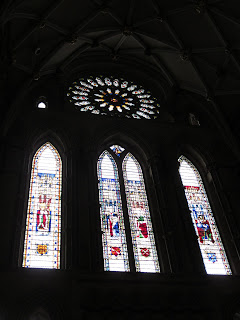
Stained glass window inside York Minster
 In Medieval times, York became known for its wool trade and then became England's second city. Henry VIII used the city's Minster as the Anglican Church's northern capital. The religious importance of York continues today as the Archbishop of York in the Anglican Church is second only to the Archbishop of Canterbury - if you remember, I talked about the Archbishop of Canterbury when I blogged about our trip to the Dover Castle.

In the Industrial Age, York became the railway hub of northern England. When it was built, York's train station was the world's largest station. Their train station remains one of my favourite train stations. The arched ceilings and metalwork within the structure itself are totally amazing.

York's leading industry today is tourism. Once you have visited York, you will quickly find out why tourism is the leading industry - there is just so much to see and do there!

York Minster church is the largest Gothic church north of the Alps. Because it is the seat of a bishop, York Minster is also known as a cathedral. Although Henry VIII destroyed England's great abbeys, York Minster was spared because it was not part of a monastery. The church comfortably seats 2000 people - it is a sight to see. I have not yet gone inside York Minster to check out the whole place. My goal is to actually get into the church the next time I go to York...maybe Greg will go with us in a couple of weeks :)

One thing I have learned about British history is the close relationship between church and state. The Anglican Church (the Church of England) was born in 1534 when Henry VIII declared that he was the head of England's Catholics. In this statement, he disowned the Catholic faith and pushed Pope Clement VII out of England. All this basically happened because Henry wanted to divorce his wife to marry Ann Boleyn. Because the Pope wouldn't grant his divorce, Henry decided to overthrow the Pope. Henry eventually divorced his wife, married Ann, and they had a daughter, Elizabeth, who would one day become Queen Elizabeth I.

Henry still regarded himself as Catholic - he just wasn't Roman Catholic - so the Catholic mass and the Anglican service are very similar - even still today. Henry's son, Edward VI, instituted many of the changes that Reformation Protestants brought on in many European cities. There was an emphasis on preaching, people actually began to read the bible, and clergy were allowed to marry. When Edward died, his sister, Mary I, took over in the middle 1500's. Being Catholic, she changed England back to the Roman Catholic Church. She earned the nickname "Bloody Mary" because of her brutal suppression of the Protestants.  Now I know where bloody Mary's came from - now if I could just figure out the beer chaser part of the drink :) This didn't go over too well with the English, and when Elizabeth I succeeded Mary with the throne, the English broke away from the Roman Catholic church one more time.
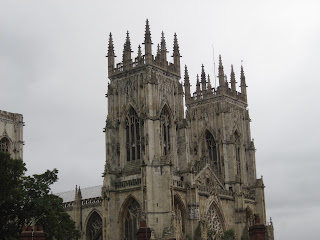
View of the spires from the city walls
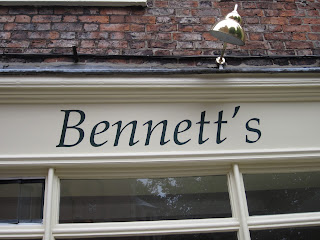
A restaurant outside of York Minster - Bennett, I was thinking of you on this trip!
 In York, an important thing to remember is that a "bar" is a gate and a "gate" is a street...I know it is confusing, but it is a Viking thing :) One of my favourite things to do in York is to walk the walls around the city. The walls were originally built by the Romans and then were expanded by the Normans in the 12th century to assert control over northern England.
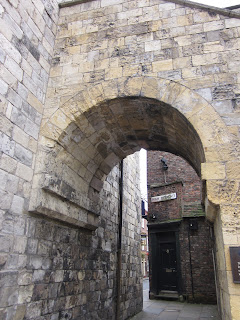
One of the bars leading up onto the wall


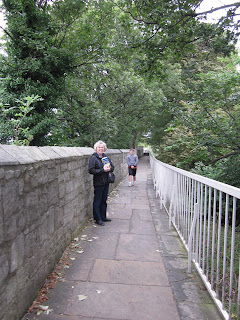
Mom and Isaac walking along the wall
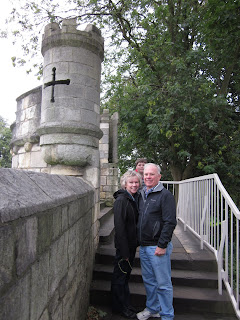
More pictures on the wall - where's Isaac?

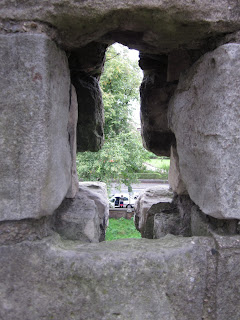
A look through a hole in the wall
 I took the next couple pictures for Mike and Myra (Greg's boss and his wife), who are master gardners - I really loved this garden - even in the cold gray day we had in York, the colours were so vibrant, and I was thinking of their gardens. What I find most amazing is that the British are able to have incredibly beautiful spaces without a whole lot of land...how do they do it?


I think this is the Monk Bar behind me


 The views from different parts of the wall are just amazing. You can see York Minster just about wherever you go. Also throughout the wall there are square notches at the top of the walls called pivots that were used to provide cover for archers who were defending the city.
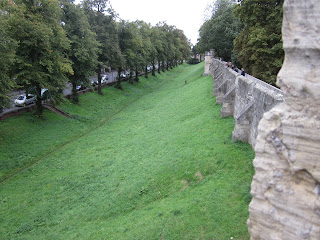
The moat
 Now you may wonder why the moat doesn't have water in it. Well the best I can tell is that the majority of moats at least in England are dry moats - what this means is that they didn't have water. However, the land and ditches were so steep that they protected the walls of a city or a castle quite well. I am beginning to think that wet moats are a creation of Hollywood - I guess I'll have to keep searching for a moat with water in it :)
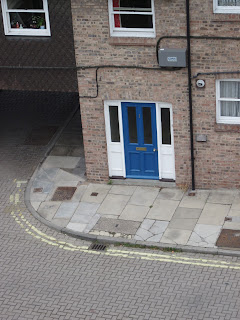
A blue door
It seemed like everywhere we went over the past few days, we ran into bright blue doors. I am not sure the significance of the blue doors, but Mom is thinking she needs to paint her door blue - I think I need to find out why the doors are blue before we start painting ours this colour :)  As we continued down the wall and through the city, we ended up running into the York Food Festival. It was quite the experience - there was food everywhere!
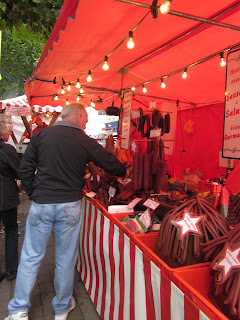
Checking out the hot sausages from Germany

Chocolate kabobs - I think Mia might have some competition in the dessert kabob category!
 After going through the food fair and a Marks and Spencer, which is a grocery store combined with a really nice department store, and watching the Ryder Cup for a few minutes in the men's department, we decided to continue our journey through the shambles. The shambles is a really cool place in York. Shambles comes from the word "shammell" which means a butcher's cutting block. In the 16th century, this part of York was busy with butchers and any kind of red meat. People lived above the stores and all the garbage was flushed down the street to a really mucky pond at the end of the road. This was a favourite place for the dogs and cats of York to hang out. Today, the Shambles is known as one of the most haunted places in England...I haven't been there at night to check it out yet :)


A typical view down the Shambles
 The thing that amazes me every time I see the Shambles is how the houses come into the street as they were built up. I am not quite sure how they remain standing - and if you look carefully, in the Tudor building behind me in the picture below, the houses and buildings actually sag...
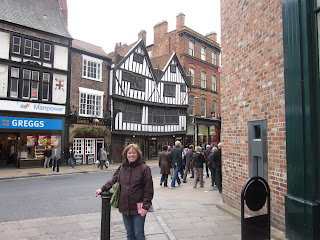

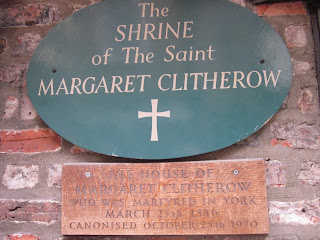
 As we walked through the Shambles, we came across the shrine to Saint Margaret of Clitherow. St. Margaret is the first woman who was sentenced to death under the rule of Queen Elizabeth. She was born in Middleton, England in 1555 to Protestant parents. She was good looking and had a great personality - history says she had good wits and like to have fun - sounds like my kind of girl! In 1571 she married John Clitherow, a butcher. Margaret and John had 3 children (Henry, William, and Anne) and Margaret converted to Catholicism. She wanted her son to go to a Catholic school in France, and she was known to pray for her 1 1/2 hours every day. She also fasted 4 days a week. When laws that forbid people from attending Roman Catholic masses were passed, St. Margaret continued going to church. She was imprisoned many times because she would not go to Protestant services. Her zeal for her religion led her to harbor fugitive priests. When the British found out what she was doing, they took her to trial and tried to make her  made her denounce her faith. St. Margaret was totally committed to her Catholic faith and would not budge. So she was ordered to be pressed to death on March 25, 1586. She was stretched out on the ground, with a sharp rock on her back. A door with a bunch of weights was placed on top of her and her bones started to break. She died within 15 minutes. The feast day of Saint Margaret is March 26th. St. Margaret was only 30-years-old when she died. I am amazed at how strong her faith was despite her age and the social circumstances that surrounded her. I also am sad about her children - I can't imagine what it would be like to lose your mother in such a horrible way at such a young age. In case you were wondering, St. Margaret had a big influence on her children; her 2 boys became priests and her daughter became a nun. St. Margaret was an amazing person.

As we walked out of the shrine to St. Margaret, Isaac and I decided we needed to start heading back to Grantham. He had school the next day and we were both getting tired. He also wanted to walk on the walls some more. As we started walking back to the city walls, we ran into a guy on an 8 foot tall unicycle...now we started thinking about Greg - now this guy has one up on Greg - not only does he ride a unicycle, but he also juggles flaming torches while he is up in the air. It was pretty entertaining.
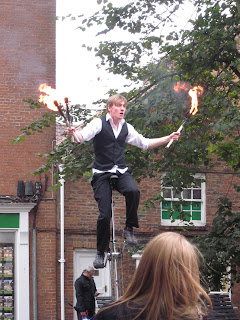
Juggler on an 8-foot tall unicycle - I am not sure how he did it - it was pretty amazing!
 On our way back towards the walls, we spotted this really interesting gate. So we decided to go through and see what we could find.
I am not exactly sure what the name of this church is, but it was really old and pretty cool. It was just stuck in between a bunch of houses and buildings - there were houses and buildings on all sides of it. I wondered how it got there - was it built first and then the buildings were built around it? Or were the buildings put there first? And why would you build a church that you could only access by foot? There was no parking lot - in fact, the space was so tight, that I couldn't even get a picture of the entire church. It was pretty amazing. We continued on our journey on top of the walls surrounding York. Isaac loved the walls....


And I enjoyed the gardens as well as the views from the wall..what a magical place!
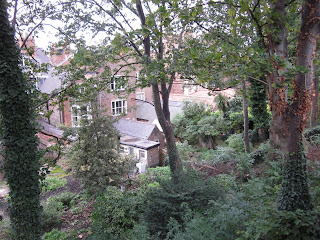
What a gorgeous view!
 As we headed off the walls and back towards the train station, we happened upon some incredible sites. First we saw the Abbey Hospital ruins. The hospital is from the 13th century and has ancient Roman tombs stacked under its vault. The tombs were discovered when a new train line was being built.
Abbey Hospital
 Next we wandered into a beautiful garden and a multangular tower.


The Multangular Tower
This tower was built by the Romans in AD 300 and has 12 sides to it. The lower stones are Roman while the upper, bigger stones are medieval. When Rome fell, York suffered through 2 centuries of a dark age. Then the Vikings ruled from 780 to 1066. The Vikings built everything out of wood. In 1066, William the Conqueror came, and the Normans replaced the wooden structures with stone. It was normal for them to build on top of the existing Roman structures - as they did in this tower. We then got to see St. Mary's Abbey. The abbey dates back to the days of William the Conqueror whose harsh policies, massacres, and destruction made him pretty unpopular in York. His son, Rufus, tried to improve relationships with the people who lived in York at the time by building a great church here. The church became an abbey and thrived until the dissolution of the monasteries in the 16th century - which was a result of Henry VIII. As I think about all the events in history that have occurred in York, I am amazed at how intertwined the stories become. I also am struck by how much impact one person can have on a country and on civilization. I am sad too because I believe Henry VIII destroyed beautiful buildings just because he was upset with the Pope. He wanted his subjects to pay him taxes instead of paying tithes to the Pope - so not only was this destruction related to religion, but it also was related to greed and money.
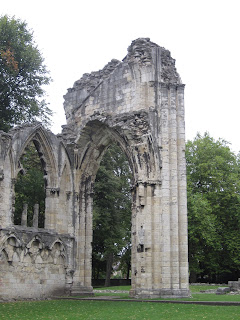
St. Mary's Abbey

More of the Abbey


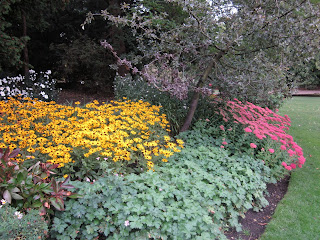
More of the gardens - I love the black eyed Susans! This was called a fall garden.
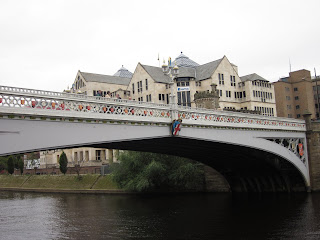
We left the gardens and continued on our way across the River Ouse. Isaac thought it would be cool to go down by the boats, so off we went, under the bridge and then back on top of it. As we journeyed back to the train station and then off to Grantham, I continued to reflect upon all I had learned today. First of all, once again, I realized how old "old" really is. When you think that we were looking at and walking on structures that were built shortly after the birth and death of Christ, you can't help but be amazed by how these structures can still be standing today. I also was reminded of the brutal relationship between church and state here and why the American colonists fought so hard for separation of church and state. I am saddened by the fact that Queen Elizabeth felt she had to kill people like St. Margaret who were Catholic - I know the queen believed that she had a good reason to do it, but just the same, it makes me wonder about the sanity of the world during that time. Our history is not kind.
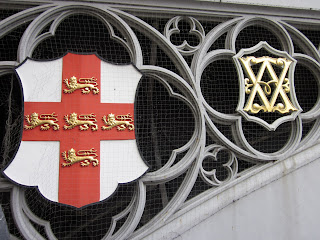
Really cool ironwork in the bridge over the River Ouse in York

Bridge over the River Ouse
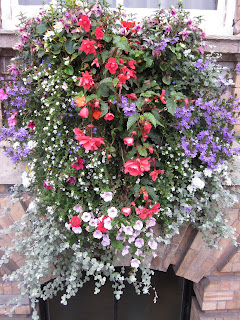
Flowers on a hotel building in York - how gorgeous!

And then I can't help but reflect about the wars that are going on now. Someday someone will probably wonder what we were thinking and why we can't just all get along. I also am reminded of how blessed I am to be able to share all this with Isaac and with my mom and dad. We have packed so much into so few days...how amazing it is that we have this opportunity. I am thankful for the gifts I have received and for the reminders of God's presence in nature all around me. Life is good, and so is God. I can't wait to come back to York someday - hopefully we will get back at least one more time before we leave...and some day I may tell the story of New York - believe it or not, there is a story there too!